
Starting from Scratch
You’ve had the idea for months - maybe even years - but every time you sit down to start creating it, you’re unsure where to begin.
That's Where I Can Help...
You bring the subject knowledge. I bring the training expertise.
You know you have knowledge and experience that other people could benefit from.
But turning everything you know into a well-structured training course is another skill altogether.
Where do you start?
What should you include?
What should you leave out?
What order should you teach things in?
How much content do you actually need?
Where should you include exercises or practical work?
How will you know that people have actually learned what you are teaching them?
And what if you eventually want your training externally accredited or delivered by other trainers?
These are the things that can turn what initially seemed like a great idea into months of going around in circles, until you get so overwhelmed you don’t do anything at all!
A focused one-to-one service
To turn your expertise, ideas and existing material into a clear plan for your training course.
Whether you’re starting with an idea or have already created part of your training, we’ll work out what the course needs to achieve, how it should be structured and what you need to do to get it built.
01
Before we meet, you’ll complete a Training Course Development Questionnaire.
02
Then we’ll spend two hours working on your training course together.
03
As we work, we’ll start building the structure of your Training Course Blueprint so you can see your training taking shape.

You’ll be taken to the secure checkout to complete your purchase.
What will we work on?
Every training course is different, so our session will concentrate on what yours needs.
We’ll look at:
Focus on what matters
who your training is really for and what they should already know before they start;
what you want someone to know and be able to do when they finish;
what genuinely needs to be included - and what doesn’t;
how to organise your knowledge into a logical learning journey;
the structure and order of your modules or sessions;
where practical exercises, demonstrations and opportunities to practise are needed;
Plan a clear structure
how you will establish whether people have actually learned what you are teaching;
the most appropriate way to deliver the training;
the materials you actually need to create;
whether certification is appropriate;
anything that should be considered now if you may eventually want external accreditation; and
what would be required if you want other trainers to deliver your training in the future.
The aim isn’t to make your training course bigger.
Quite often, I may help you make it smaller.
Everything should have a reason for being there.
By the end, you’ll know what you’re building - including the things you may not have realised you needed to consider.
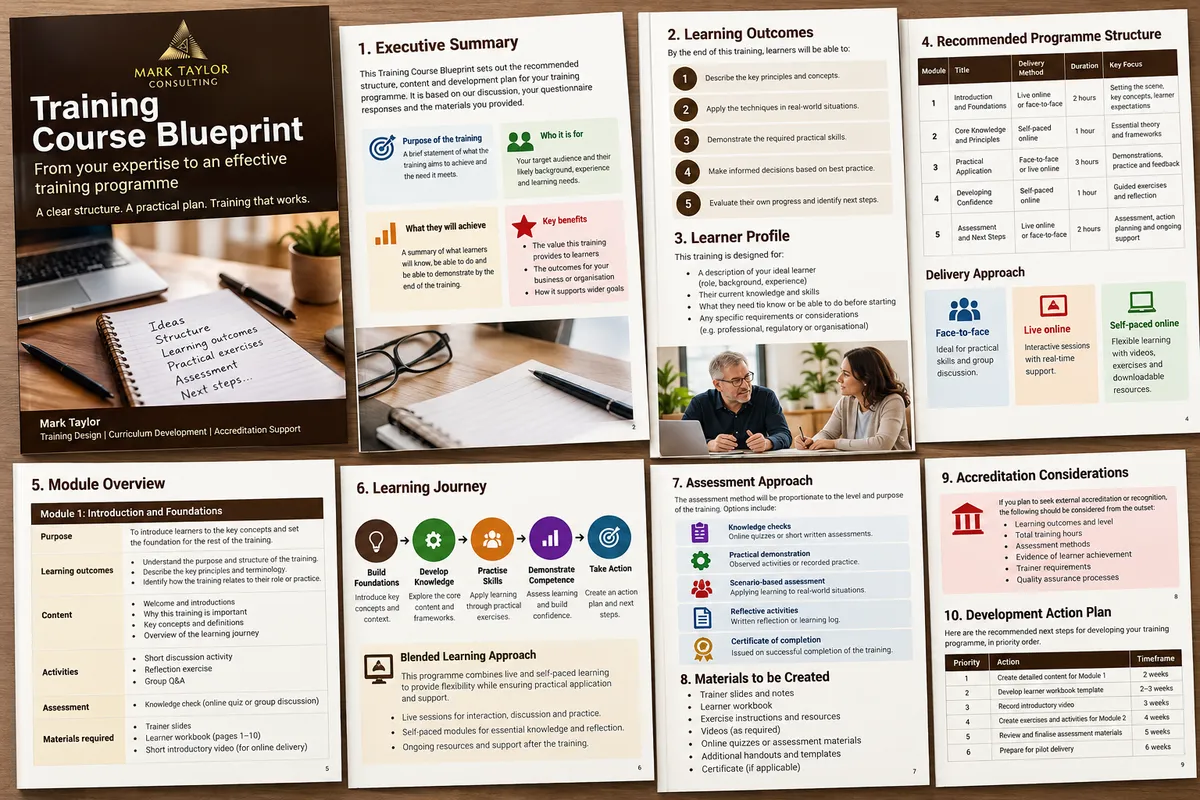
Following our session, I’ll complete and send you your personalised Training Course Blueprint.
And importantly, the Blueprint won’t simply organise the ideas and content you already have.
Part of my role is to identify the things you may not yet have considered.
When you’re an expert in your subject, it’s natural to concentrate on what you want to teach.
But designing effective training involves much more than deciding what content to include.
We also need to consider how people will learn it, what order they need to learn it in, where they need opportunities to practise, how you’ll know they’ve understood it, what competence looks like and, where appropriate, how that learning should be assessed or certified.
There may also be considerations around delivery, trainer materials, learner resources, quality assurance, external accreditation or enabling other trainers to deliver your programme consistently.
These are often the things people only discover after they’ve already spent months creating their training.
By identifying them at the Blueprint stage, we can build them into your thinking from the outset rather than discovering later that significant parts of the programme need to be changed.
Your personalised Training Course Blueprint
may therefore include:
01|Purpose & learners
The purpose of your training
Who it is designed for
The starting point of your learners
What they should achieve by completing it
Your key learning outcomes
02|Structure & practical learning
The recommended structure and sequence
Your modules, sessions or training stages
The purpose of each module or session
Practical exercises and activities required
How learning or competence could be assessed
03|Delivery & materials
Recommended delivery approach - face-to-face, online or blended
Materials you need to create
Considerations if other trainers will eventually deliver the programme
04|Recognition & next steps
Certification considerations
Future accreditation considerations
Any important gaps or issues you may not previously have identified
Your priority actions and next steps
So you won’t simply leave knowing how to organise the content you already have.
You’ll have a much clearer understanding of what your training programme actually needs in order to work - including the things you may not have known to ask about in the first place.
Ready to get your training moving?
You’ll be taken to the secure checkout to complete your purchase.

Thinking about accreditation?
You don’t need to have your training externally accredited.
But if there is a possibility that you may want accreditation or recognition from a professional body in the future, it is worth thinking about it before you finish developing the training.
External bodies may want to see much more than good course content.
They may look at areas such as learning outcomes, training hours, assessment, practical competence, trainer requirements, quality assurance and evidence that learners have achieved what your certificate says they have achieved.
Building these considerations into your training from the outset can save a considerable amount of redevelopment later.
We’ll identify any areas you need to consider as part of your Training Course Blueprint.
A detailed review against the requirements of a specific accrediting organisation is a separate service.
Your Training Course Blueprint
Your investment is £750.
This includes:
Your pre-session Training Course Development Questionnaire
So I can understand what you want to create, where you are now and what you want your training to achieve.
Two-hour one-to-one Training Course Blueprint Session
We’ll work on your training together, making the key decisions about its purpose, structure, learning journey, delivery, practical elements and assessment.
Your personalised Training Course Blueprint
I’ll complete the Blueprint following our session so that you have the structure and development plan we have agreed.
Your priorities and next steps
You’ll know what needs doing and in what order.
You’ll be taken to the secure checkout to complete your purchase.
Not sure whether it’s right for you?
You don’t need to book a call to find out.
Tell me briefly what you’re looking to create and where you’re currently stuck,
and I’ll let you know whether the Training Course Blueprint is the right place to start.
This button opens a short enquiry form.
STILL NOT SURE?
Frequently Asked Questions
Can’t I just use AI to create my training course?
You can certainly use AI to help you create content - and used well, it can save a huge amount of time. But creating content and designing training are not the same thing.
AI can give you module ideas, write explanations, suggest exercises, create quizzes and produce pages of course material in seconds.
The question is whether what it has produced is actually the right training.
Does it start at the right level?
Are the learning outcomes appropriate?
Is the content in the right order?
What needs to be taught and what needs to be practised?
Is there too much content, or is something important missing?
Do the exercises actually develop the skills being taught?
How will you establish whether someone can apply what they have learned?
If you issue a certificate, what does that certificate actually demonstrate?
And if you later want external accreditation, has the training been designed in a way that gives you the foundations you will need?
AI can help enormously with the production of a training course.
But someone still needs to make the decisions about how that training should be designed.
That’s where curriculum expertise matters.
I can help you create the structure first - the purpose, learning outcomes, learning journey, modules, practical elements, assessment and delivery approach.
Once that framework is right, AI can actually become far more useful because you know exactly what you need it to help you create.
Use AI to help build your training. Don’t ask it to make the important training decisions for you.
Thinking about accreditation?
You don’t need to have your training externally accredited.
But if there is a possibility that you may want accreditation or recognition from a professional body in the future, it is worth thinking about it before you finish developing the training.
External bodies may want to see much more than good course content.
They may look at areas such as learning outcomes, training hours, assessment, practical competence, trainer requirements, quality assurance and evidence that learners have achieved what your certificate says they have achieved.
Building these considerations into your training from the outset can save a considerable amount of redevelopment later.
We’ll identify any areas you need to consider as part of your Training Course Blueprint.
A detailed review against the requirements of a specific accrediting organisation is a separate service.
What does the pre-session review include?
If you’ve already started creating your training, I’ll review the core materials needed to understand the programme, its current structure and where you’re stuck.
This isn’t a detailed audit or edit of every page, slide or video you’ve created. We’ll agree beforehand which materials will be most useful for me to review.
If you have a particularly large or complex programme that requires a more detailed review, I’ll let you know before you book and we can discuss what would be appropriate.
There will be no unexpected additional charge once we have agreed the scope.
What happens after you book?
You’ll receive your Training Course Development Questionnaire and details of how to send me any agreed existing materials.
Once I have those, I’ll review everything before our session.
We’ll then spend two hours working on your training course together.
Following the session, I’ll complete your Training Course Blueprint and send it to you with your agreed priorities and next steps.
Then you can get on with building your training.
What happens afterwards?
You may decide you have everything you need to go away and build the training yourself.
That’s absolutely fine.
If you would like further help, I can also support you with developing individual modules, exercises, assessments, trainer materials and learner resources, or help you prepare the programme for external accreditation.
Any additional work is discussed and agreed separately.
There’s no requirement to take any further service.
How long will it take to receive my Training Course Blueprint?
Once you have completed your questionnaire you will be offered a call from 5 days later and then your blueprint will be with you 48 hours later.
Couldn’t I just sit down and work out the structure myself?
Possibly - particularly if you already have experience designing training.
But creating a professional training course involves much more than organising your knowledge into a logical series of topics.
You need to consider where your learners are starting from, what they need to know or be able to do by the end, the order in which learning should happen, where practical experience is needed and how you’ll know whether someone has actually learned or can demonstrate what you’re teaching.
Depending on what you're creating, there may also be questions around assessment, certification, trainer materials, quality assurance, accreditation and whether the course could eventually be delivered by someone other than you.
And some of those may be things you haven't even realised you need to consider yet.
That's where my experience comes in.
I'll help you look beyond the content you already have and identify what your training actually needs, so you can build it on the right foundations rather than discovering later that important elements have been missed.